Posts Tagged ‘comedy’

Is it me, or do these people look really pissed off? Way to wow the employer...NOT.

Job fairs can be helpful to you in your job search. While you can’t expect to go to a job fair and meet the Magic Job Search Genie who will grant you all your employment wishes, job fairs can be useful for networking (with other job seekers as well as employers), shmoozing with employers to get info on opportunities, and yes, even getting actual job leads.

However, as in any other professional and/or social situation in this life, there are some inappropriate job fair moves that will likely give you a bad rep. Here are some of them:

  • Dressing for a day at the beach. Even though you’re not actually at a job interview, if you don’t dress as though you are, no one will be impressed. I don’t care if it’s 95 degrees out and hailing stones the size of Rotweilers. You need to dress professionally for a job fair. Bring your job fair clothes in a (professional-looking) tote and change into them before you walk in, if you must.
  • Butting in line. It was rude in grade school, and it’s rude now. There are going to be lines before the employer tables, especially for the more popular companies. Deal with it.
  • Rambling on until the employer’s eyes glaze over. This is bad for several reasons (in addition to the eye-glazing). One, it’s much more effective to be focused on what you have to offer, and opportunities the company may have that fit what you have to offer. So practice your elevator pitch before you chat with employers. Two, it’s rude to take up too much time when there’s a line of other job seekers. Three, you don’t want the employer to think you’re a boring bag o’ wind. Being a boring bag o’ wind won’t help you get a job.
  • Accosting employers in the bathroom. Especially if they’re in a stall. Although come to think of it, standing next to you at a urinal is just as bad. I mean, come on. Let the poor guy piss in peace. You may think only a mentally challenged person would do this, but I’ve actually seen it, and the person who did it was clearly not mentally challenged. Horrifyingly clueless, surely, but not mentally challenged.
  • Ignoring your fellow job seekers. You’re not competing for the Stanley Cup. Every last one of you is unique in what you have to offer, and even if some of you are looking for similar positions, you’ll be much better off helping each other. That’s often how job seekers get good leads. You know, networking.
  • Being unprepared. Just as you would for an interview (yeah, I know you would), research each employer whose table you’re visiting. The company list and available positions are almost always available via whomever’s hosting the job fair, at least a few days prior to the event. Peer at the companies’ websites, look at the positions they’re trying to fill, and mention something specific about the company when you talk with the employer (you can prepare a cheat sheet beforehand). And of course, have your elevator pitch ready to go.
  • Ask dumb questions. This follows from the previous point – if you’ve done some research on the companies you’re interested in and you’re prepared, you’re not going to be asking questions like, “What does your company do?” or “Do you have any jobs that don’t require a criminal check?”

The elevator pitch, sometimes known as the 30-second infomercial, is one of the most important tools in your job search along with your resume, self-esteem and breath mints.

The elevator pitch is your (short) spiel about yourself professionally; how you market yourself verbally. That doesn’t mean you just spit it out to anyone and everyone you meet, including people in an actual elevator. The guy on the stretcher next to you in the emergency room, where you’ve landed after tripping over your dog’s foot and banging your nose on the coffee table, may not want to hear it. You do, however, want to say it when it’s appropriate, like when you’re asked the question in an interview, “Tell me about yourself.” Or in the formal portion of a networking event when you’re asked to stand up and introduce yourself for a minute or less. Or when you’re chatting with someone and you give them the first sentence or two of your “pitch” and they ask for more details. You want it to sound conversational, and you want to tailor it to your audience – if you’re a techie and you’re talking to other techies, you can use techie terms, whereas non-techies won’t know what the hell you’re talking about.

So what do you say in the elevator speech? Well, here’s the pitch (hey, felt like I was a Red Sox commentator for a minute there.  Anyway).  The pitch is essentially made up of four parts:

  • I am… as in, your name. I’m going to assume you don’t have any trouble with that one.
  • I do…a job title that accurately describes what you want to do; how you want to market your area of expertise. Or if a job title would leave too much room for perplexity, some detail that clarifies what you want to focus on. For example, “I run a pet waste elimination company” kinda says what you do, but it’s not as clear as, “I run a company that scoops your dog’s poop.”
  • I help…a little more detail about how your skills would benefit a company, your clients, and/or the world at large. To add to the example above, “We come to your house and clean your pet’s waste from the yard, and sprinkle fragrant organic herb particles that get rid of the odor, so your yard smells great.”
  • I need…Not as in, “I need a job,” but the idea is to say what you’re looking for, and where: “I’m looking to expand my business to pet-owners in the North Shore area.” Or more specifically for those looking for a job in a company, “I’m looking to use my blah blah skills in a small or medium-sized pet-related business.”

Make sure to put it all in a positive light; don’t just say, “I’m unemployed.” Even in your description of what you have to offer, it’s better to say, “…so your yard smells great….” than, “…so your yard doesn’t smell like shit.”


While every organization’s different and there isn’t any one right way to behave in a job interview, there are some wrong ways no matter who you’re talking to. Here are some ways to horrify your job counselor:

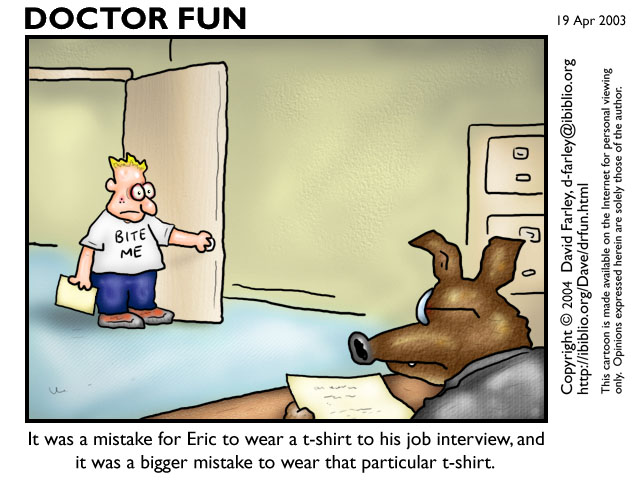
  • Wearing an outfit better suited to a hot date than a job interview. Even if you’re interviewing in a club, it’s better to dress a bit more formally than you would once you were in the job. And of course, nix the bouncing boobs. Even if the interviewer’s really really cute.
  • Rambling on and on. Your little 30-second elevator pitch (more about that in a later post) shouldn’t last twenty minutes. The person interviewing you doesn’t want to hear about your entire work history from the time you babysat for your neighbor when you were in high school, or the details of your first diaper-changing experience. Keep it to the point, the point being your experience and skills that are relevant to their needs.
  • Sharing personal info. Even if you’ve discovered the interviewer is a fellow Buffy the Vampire Slayer fanatic, don’t assume they’re your friend. They still could care less about your imaginary childhood friend or how your divorce has made you an atheist. Keep it professional.
  • Forgetting to check your appearance before you go into the interview. You don’t want to visit the men’s room afterward and discover that you had a big fat gob of mustard on your chin the whole time.
  • Talking smack about your former employer. Even if your former supervisor could win the Suck-Ass Psycho Boss of the Year Award, it still makes you look bad. The interviewer will wonder what you’d say about HIM after you’d worked there awhile.
  • Acting all humble and insecure. We all have our insecurities, and job interviews can be stressful, but you want to show confidence. You have skills; you have a lot to offer. If your attitude is, “why in hell would you want to hire ME?” those little negative thought molecules will wriggle out of your head and worm their way across the conference table and into the interviewer’s brain, which won’t be good news for you.
  • Not preparing answers to questions you’ll likely be asked. Yes, ideally a job interview should be more like a conversation in which you’re sharing information than like a firing squad, but you’ll still be asked questions that are typical of interviews, and it would be stupid not to put some prior thought into how best to answer them. And I know you’re not stupid.
  • Not preparing questions to ask. Again, think mutual, give-and-take, information-sharing situation to see if it’s a match. Besides, you don’t want it to seem as if you don’t give a crap.
  • Not researching the company beforehand. If you know little about them, how do you know it would be a good fit? And how can you address this in the interview? Besides, you will likely be asked the actual question, “What do you know about us?” and you don’t want your answer to be, “Nothing.”
  • Being late to the interview. Unless you’re in a hostage situation and are seen on Fox News successfully negotiating with the kidnapper, you may as well hang it up right there. If something unforeseen does happen, at least call before you’re supposed to be there, apologize for keeping the employer waiting, and keep your explanation brief – don’t give an elaborate explanation of how your pet lizard died, you tried to flush him and the toilet flooded.


There’re things you just don’t want to do online when you’re doing a job search, if you don’t want to be left mangled on the side of the road. Here are a few:

  • Post photos of yourself drinking, smoking, taking a bong hit, making out with someone, doing lines off your pet iguana’s head, exposing body parts you wouldn’t normally expose in a job interview, engaging in bodily functions you wouldn’t normally engage in in public, or doing anything else you wouldn’t want a prospective employer to see. Yeah, I know Facebook is supposed to be for fun stuff and not for professional networking, but the hard reality is that a year ago, nearly 50% of employers recently surveyed confessed they peek on candidates’ social networking sites (more detail in this article —http://www.insidefacebook.com/2009/08/21/career-builder-45-of-companies-check-out-candidates-on-facebook/).  And that was a year ago, so I’m betting that percent’s a helluva lot higher now. So get used to it.
  • Make snarky comments about your current or former boss, co-workers, etc. Just as this won’t win you any points in an interview, it’ll turn off prospective employers online, too, or get you fired from your current job. Not smart.
  • Talk about your job search online when your current boss doesn’t know you’re looking. Guess what? Your boss knows how to use the internet too.
  • Make racist/sexist/ageist/other “ist” comments anywhere online. Even if it’s not on your own site, comments on other people’s blogs can rear their ugly little heads in a search. So just don’t.
  • Post content with spelling and grammatical errors. Unless you’re made out of straw, you were not the “office manger.” Generally, employers want to hire people who are literate and pay attention to detail.
  • Lie. It’s just as icky even if it’s not on your resume. Don’t say on your LinkedIn profile that you graduated from Harvard if you didn’t, or worked for a company who never heard of you, or held a management position when you were an administrative assistant. It’s too easy to check that stuff, and most employers don’t like dishonesty.
  • Broadcast confidential information about your current or former employer. Talk about untrustworthy. Not cool.


While it’s important to ask questions in a job interview to make it a mutual exchange, get more info, and show interest, there are some questions that aren’t a good idea to ask. Here are a few:

  • How many sick days would I get? – Once you’ve had an offer, it’s okay to ask about benefits as part of the negotiation process, but you don’t want to ask about that stuff until then. It makes it look like that’s all you care about. And of course, if you ask about sick days, it’ll imply that you need them because, well, you’re sick.
  • Who was that hunk in the lobby? – I know you wouldn’t really ask that, would you? Of course you wouldn’t.
  • Where are you from? I can’t quite place the accent. Believe it or not, sometimes clueless employers ask these kind of questions. You certainly don’t want to be the idiot applicant who asks them.
  • I didn’t have time for lunch. Do you mind if I eat my sandwich while we’re talking? You do want to establish rapport in an interview and have a conversation rather than an interrogation, but chomping on your Chicken McNuggets won’t exactly bowl over the employer.
  •  How flexible is your company on the 8:00 a.m. thing? Now, many companies do have flex time, and you may need to be aware of their policies around it (once you have an offer) if you have kids, an insomniac dog, or an alternate vampire identity, but otherwise, well, don’t ask.
  • Has your company ever been sued? It’s a good idea to sniff around Google to find out as much info on them as you can, as well as to discover any dirt on them that would make you run for the hillocks, but it isn’t a question to actually ask them. I mean really, it’s just rude.
  • What other jobs are available here? Even if you’d give your left nostril to work for that company and are possibly interested in positions similar to the one for which you’re interviewing, you don’t want to sound like you’re not interested in that one. If it’s clearly not a fit and you decide not to pursue it, in your thank-you letter you can always ask at that point if there are any other open positions that would be a better match. If you ask in the interview, it’s kind of like asking your date if he has a single brother. 


You (hopefully) know a lot of what to do when you and your last job have parted ways. Network, volunteer, join groups, do a targeted search, blah blah blah. Here are some things NOT to do when you’re not working:

  • Stay in bed (alone) until 2:00 p.m. If you’re not alone, then by all means go for it. Well, maybe not every day. You wouldn’t have enough energy left to do a job search. But staying in bed half the day alone is kinda like drinking alone – it’s more depressing and dysfunctional than fun. You don’t have to get up at six a.m. if you’re not a morning person and you don’t have any early appointments that day, but before 10:00 is probably a good idea (can you guess I’m not a morning person??).
  • Watch TV in the middle of the day. It may be tempting to catch up on Jerry Springer and see whose life sucks more than yours, but that’s not a habit you want to get into.
  • Spend hours looking at online job boards and applying for listed job openings. Yes, it’s easy (well, relatively speaking). Yes, it makes you feel like you’re accomplishing something when you actually apply for jobs that are listed. But you know where that usually gets you, don’t you? That’s right, you’ll be sucked into the Job Seeker Vortex of the Apocalypse. Don’t say I didn’t warn you.
  • Eat all day. I don’t think I need to elaborate on that one.
  • Spend a lot of time rearranging your underwear drawer. You may think, “Oh good, now I have time to do all the pesky household stuff I never have time for.” By all means, clean the house and use the opportunity to catch up on some of that other stuff, but don’t use it to avoid job search activities. If you’re spending more time alphabetizing your toiletries than doing job search stuff, you’re in trouble.
  • Staying up late every night. This goes along with the first one, of course, cuz if you’re out drinking or just up watching Nick at Nite, it’ll be hard to get up at a reasonable time. I fell into this trap when I wasn’t working – at one point, I was going to bed at 3  a.m. and getting up at 1:00 in the afternoon. Needless to say, I didn’t get a hell of a lot done.
  • Spend most of your time hanging out with friends. I don’t mean you shouldn’t see your friends, because they’re very important. But don’t go to a Hitchcock film in the middle of the day with your buddy and call it networking.
  • Spend hours on one cover letter. Maybe the first one for a particular type of job may take longer, and you always want to target your cover letters and take time to make them as likely as possible to elicit responses (and of course proofread!), but there is such a thing as going overboard. Mildly obsessive is okay, pathological is not.
  • Spend hours every day fooling around with your resume. Yes, it’s important to tailor it to the job you’re targeting, and it always is a work in progress to a certain point, but again you can take it too far. Don’t pick at it like a scab ’til it bleeds all over your laptop.
  • Go to one networking group event after another that has absolutely nothing to do with you. I must have said this before, but I’ll say it again – although networking is the most important way to spend your job-search time, and it’s good to open up to new interests, it doesn’t pay to compulsively and gratuitously attend events on topics you could care less about. If you’re into God, guns and ammo, don’t join the Society For Atheist Tree-Huggers.

In my “Top Ten Items to Leave Off Your Resume” post, I included, well, items to leave off your resume. Here are some more:

  • Spelling and grammatical errors – yes, we know you’re an engineer and not a writer. Big whoop. It still won’t help you. Get someone who IS a good writer to proofread. Better yet, two or three someones.
  • Photos or graphics – even if you look like Brad Pitt, employers don’t want to see your picture on your resume unless you are, in fact, applying for an acting or modeling gig. If you’re not, they’ll just think you’re goofy. Same goes for images or symbols of any kind. Even if you’re a graphic artist – employers will want separate samples of your work, rather than artwork on the resume itself.
  • Objective – The worst ones are the totally noncommittal statements that are so general they say absolutely nothing. “Seeking a challenging position that allows me to use my skills.” What skills are those? Your skills at bullshit? Not that those skills don’t come in handy. Chances are, though, you’re not going for a job as a fortune-teller, so don’t expect employers to read your mind. Even if you get more specific, employers need to see more of an emphasis on what you can do for them, rather than what you want. Guess what? They don’t really care what you want. At least not before they know and love you. Don’t take it personally.
  • Lies – employers can expose them pretty damn easily. And it won’t be pretty.
  • Referring to yourself in the third person – Talk about goofy. It looks like either  a.  someone else wrote your entire resume, which doesn’t look too good,   b.  you have multiple-personality disorder, or c.  you have a Seinfeld fixation.
  • Trite, so-over phrases sure to make employers gag, such as:
    – “people person” – do people really still throw that one out into the
    job-o-sphere?
    – “results-oriented professional” – anyone can say that about
    themselves.
    – “organized” – ditto.
    – “excellent communication skills” – double ditto.
    – “team player” – unless you actually play for the Red Sox. But then,
    if you do I’m guessing you wouldn’t need a resume.
    – “quick learner and multitasker who thinks outside the box” – how
    many cliches can we toss into one bullet?

The main thing is – show, don’t tell. Give vivid, concrete examples of the above, rather than stating them like they’re the Gospel According to Saint Job Seeker.

I’ve seen a lot of stuff floating around lately about the flaming hoops job seekers are asked to hop through (one particularly interesting article can be found at http://www.huffingtonpost.com/liz-ryan/career-advice-teaching-pe_b_651880.html). Absurdly long online apps that ask you to describe the first time in your life you belched up your Gerber’s applesauce. Personality tests with statements to agree or disagree with, such as “I often hear voices that tell me to do bad things.” A hiring process that includes ten interviews, a request for a 20-page strategic plan, and a sword fight.

So what do you do if you really want the job, and your unemployment insurance barely supports your chocolate habit?

It’s up to you, but I personally think that any company that requires you to genuflect is probably not worth your talents. After all, you have a lot to offer, don’t you? Of course you do. So don’t assume you have no choice but to fall on your knees, bow your head to the floor and mutter, “I’m not worthy” because we’re in a crappy job market. And after all, if a company’s hiring process is that horrifying, how much worse would it be once you  actually work there??

Now, I understand why you might feel the pressure to just endure the snafus with which you’re presented. The job market is still kinda scary (though it’s starting to look up. Really.), and being unemployed is no fun. Believe me, I’ve been there. But you’re the only one who is in charge of your career, and if you base your choices on desperation, you’ll only end up screwing yourself. Which is never as much fun as… well, let’s not go there. Let’s just say that desperation is never a basis from which you want to operate. And finding a job is a mutual benefit situation, remember?

There are lots of different ways to network effectively, and a few ways not to network if you don’t want to bug the hell out of people. Bugging the hell out of people is generally not an effective strategy.

Seven Networking Dos

1.   Make a list of contacts, including relatives, friends, ex-co-workers and supervisors, ex-spouses (well, maybe not them), other professionally-related people you know such as vendors you regularly worked with, people with whom you’re in some kind of interest or community group, ex-classmates, instructors, etc.

2.  Connect or reconnect with these folks around something you have in common.

3.   Get out there. Attend events, take classes. Go to professional networking events related to your field, networking events not related to your field, fundraisers, events related to your interests, parties, barbeques, bar mitzvahs, bachelor parties, etc., etc., etc. The more opportunities you have to chat with friends, acquaintances, and strangers, the better. As long as you don’t get too schnockered.

4.  If you haven’t already, join professional organizations related to your field if they’re not too pricey for your current financial situation.

5.  Whether it’s with someone you know intimately or a total stranger, in person or online, always make it a “mutual benefit” encounter. It’s not just about you and your job search. What can you do for them? Come on, you can think of something.

6.   Develop a positive online presence. Yes, I said “positive.” More on that below in the “Don’ts” section. Build a professional presence related to your field, and/or another topic you have a lot of knowledge about. Get on LinkedIn and Twitter. Join online professional/interest groups, post articles, (intelligently) comment on others’ blogs.

7.   Remember you have tons of talents and knowledge to offer, and you can be a valuable resource to others even if you don’t happen to be working right now. So strut your stuff a little. Not in an obnoxious way, rather in a confident “I-have-the-goods” kind of way.

And Now For the 7 Networking Don’ts:

1.   Don’t harass people. It may sound obvious (at least, I hope so), but no one will want to help you with anything, much less be within fifty feet of you, if you pester them. Connect and follow up, yes, but don’t call people every day, don’t try to contact them more than two or three times at the most (not in the same hour); generally don’t be an inconsiderate asshole.

2.   Don’t be ignorant of the online impression you may be making. Facebook photos of you with your pants on your head and blog comments in support of snuff films won’t help you. Don’t know what snuff films are? Good for you.

3.   Don’t walk up to someone at an event and say, “I heard you’re the Financial Manager at Vandalay Industries. Here’s my resume. Could you spare a couple of hours to take me to dinner so we can talk about my background? Thanks a bunch.” Of course, I know you’re not one of THOSE people. Are you? If so, stop it.

4.   Don’t join groups just for the hell of it. Yes, I know we’re all human and all of us have SOMETHING in common and all that crap. You’re much more likely to find people to connect with and have stuff to say if you have a reason to be a part of that particular group other than to network for networking’s sake. If you’re an outdoor, sports-y person, don’t take a needlepoint class in hopes of finding people who can give you job leads.

5.   Don’t try to reconnect with people who probably would prefer not to hear from you. Ex-boyfriends who cheated on you (or vice-versa) wouldn’t likely be good people to attempt to network with.

6.   Don’t put anything online unless you’ve proofread it first. Spelling and grammatical errors won’t win you any brownie points.

7.   I said it before, and I’ll say it again – Don’t make it all about you. Show your interest in the other person and whatever they’ve got going on. Offer to give them info, contacts, resources, massage, whatever. Well, only the massage if you know them really well. You don’t want to give the wrong idea. But you know what I’m saying.


Most of us, to some extent, suffer from inertia when it comes to our careers. We tend to keep sauntering in the same direction until something – usually getting canned – happens to toss us off the path and into the bushes.  If you’ve been tossed, how about brushing the grass stains off your shorts and really taking a look at where you are and where you’re going.

Here are some questions to ask yourself. And, of course, answer yourself. Go ahead, you can do it in public. People will just think you have a phone in your ear. Or that you’re wacko. But what the hell.

1.   Do you really enjoy the work you’ve been doing? If so, is it because of the work itself, or because of all the hot guys on the second floor?

2.   What specifically do you like the best about your most recent job(s)?

3.   Assuming the answer to #2 isn’t the hot guys, what skills were you using when you did the stuff you liked best?

4.   What was your favorite job of all time? What in particular made it your favorite?

5.   What would your worst nightmare, wake-up-screaming-want-to-stick-a-wet-finger-in-an-electric-socket, job be? Figuring out what you don’t want to do can help you figure out what you do want.

6.   What is your fantasy job? Yeah, we know – judging the Mr. or Ms. America Pageant (do they really still have those??). Come on now, try to focus on professional stuff, like work environment, tasks you’d spend your workday doing, and type of customers you’d be working with – screaming kids? Corporate execs? Granola goddesses badly in need of anti-frizz products? What’s your preference?

7.   What’s most important to you in a job? Do you know you need to be creative? Do you yearn for structure? Do you need your job to not involve people? (just kidding on the last one – if that is, in fact, true, good luck).

8.   What are your strengths, professionally speaking? Jack of all trades doesn’t really cut it any more. Three or four strong skill areas will endear you to employers a lot more.

9.   What do you suck at? Everyone sucks at some things, though some suck more than others. Guess what? It’s okay to suck. Unless of course what you suck at is necessary for life as we know it. In which case, by all means work on it. But generally speaking, you’ll be much more successful in pretty much everything if you spend more of your time and energy developing your strengths rather than your weaknesses.

10.  Am I bullshitting myself? It’s important to dream, and dream big. And go for your dreams. But if you’re blind in one eye and you want to be an airline pilot, you probably need a reality check.