Posts Tagged ‘employer’


While it’s important to ask questions in a job interview to make it a mutual exchange, get more info, and show interest, there are some questions that aren’t a good idea to ask. Here are a few:

  • How many sick days would I get? – Once you’ve had an offer, it’s okay to ask about benefits as part of the negotiation process, but you don’t want to ask about that stuff until then. It makes it look like that’s all you care about. And of course, if you ask about sick days, it’ll imply that you need them because, well, you’re sick.
  • Who was that hunk in the lobby? – I know you wouldn’t really ask that, would you? Of course you wouldn’t.
  • Where are you from? I can’t quite place the accent. Believe it or not, sometimes clueless employers ask these kind of questions. You certainly don’t want to be the idiot applicant who asks them.
  • I didn’t have time for lunch. Do you mind if I eat my sandwich while we’re talking? You do want to establish rapport in an interview and have a conversation rather than an interrogation, but chomping on your Chicken McNuggets won’t exactly bowl over the employer.
  •  How flexible is your company on the 8:00 a.m. thing? Now, many companies do have flex time, and you may need to be aware of their policies around it (once you have an offer) if you have kids, an insomniac dog, or an alternate vampire identity, but otherwise, well, don’t ask.
  • Has your company ever been sued? It’s a good idea to sniff around Google to find out as much info on them as you can, as well as to discover any dirt on them that would make you run for the hillocks, but it isn’t a question to actually ask them. I mean really, it’s just rude.
  • What other jobs are available here? Even if you’d give your left nostril to work for that company and are possibly interested in positions similar to the one for which you’re interviewing, you don’t want to sound like you’re not interested in that one. If it’s clearly not a fit and you decide not to pursue it, in your thank-you letter you can always ask at that point if there are any other open positions that would be a better match. If you ask in the interview, it’s kind of like asking your date if he has a single brother. 

I’ve seen a lot of stuff floating around lately about the flaming hoops job seekers are asked to hop through (one particularly interesting article can be found at http://www.huffingtonpost.com/liz-ryan/career-advice-teaching-pe_b_651880.html). Absurdly long online apps that ask you to describe the first time in your life you belched up your Gerber’s applesauce. Personality tests with statements to agree or disagree with, such as “I often hear voices that tell me to do bad things.” A hiring process that includes ten interviews, a request for a 20-page strategic plan, and a sword fight.

So what do you do if you really want the job, and your unemployment insurance barely supports your chocolate habit?

It’s up to you, but I personally think that any company that requires you to genuflect is probably not worth your talents. After all, you have a lot to offer, don’t you? Of course you do. So don’t assume you have no choice but to fall on your knees, bow your head to the floor and mutter, “I’m not worthy” because we’re in a crappy job market. And after all, if a company’s hiring process is that horrifying, how much worse would it be once you  actually work there??

Now, I understand why you might feel the pressure to just endure the snafus with which you’re presented. The job market is still kinda scary (though it’s starting to look up. Really.), and being unemployed is no fun. Believe me, I’ve been there. But you’re the only one who is in charge of your career, and if you base your choices on desperation, you’ll only end up screwing yourself. Which is never as much fun as… well, let’s not go there. Let’s just say that desperation is never a basis from which you want to operate. And finding a job is a mutual benefit situation, remember?


I cautioned in an earlier post against spewing your resume. Beyond not spewing to any and every employer, you also don’t want to be the obedient little jobseeker and just trot out all your info online for the HR pod people. Trot, trot.

No, you want to make a list of places you’d give your big toe to work for, hunt around online to find the contact info for the manager/director of whatever department makes sense in terms of your field, hunt around some more to find info on the company’s goals, problems, etc., and then contact the aforementioned person to let them know how you, with your many superpowers, can help them banish the beast.

Notice I didn’t say send your resume to that person only if you see a job posted that you’re interested in. You actually have a better shot if there isn’t one. Yep, that’s what I said. If there is a job posted, everyone within a hundred miles will crawl out from under their rock to send their resume for that one job. But if you send the superpower letter for a possible opportunity that would be a fit, you can ask to set up an informational meeting to discuss the above further, without asking that person to interview you for a particular position.

Why would you want to bother, if there isn’t a job listed in which you’re interested? Well, there may very well be a job that became available ten minutes ago, that hasn’t been posted yet. Or someone is about to give notice next week. Or maybe the person who updates their website is sitting with his finger up his ass.

How do you find the manager’s name and other relevant company info? LinkedIn, baby. Do a search for the company. Also, Google the company name and the position you’re looking to connect to a person, and you can usually find it. Use your network (of course, you have one. Don’t you???) to see if you know someone who knows someone who knows someone who knows what you need to know.

By the way, when I say “superpowers,” you know I don’t mean it literally, right? It’s much more effective to show a prospective employer how your experience and talents match what they need, rather than brag about how great you are. How great you are will come out anyway, but in a much more real way. Just like with sex, it usually works out better in the long run if you don’t fake it.

Here are some that come to mind – more in a later post….

1.  How many times you’ve been married…or divorced, or engaged, or dumped, or been on a really bad date…you get the idea. Anything related to your love life doesn’t belong on your resume.

2.  Your abilities as a contortionist. Unless, of course, you’re applying for jobs with the circus, or are interested in becoming a porn star. Otherwise, bizarro skills that have nothing whatsoever to do with the jobs you’re targeting have no business on your resume.

3.  God-related activities. If you’re not applying for a god-related position (i.e., minister, mausoleum tour guide, Pope-in-training), don’t include your religious activities on your resume. Too much potential for discrimination.

4.  High-school graduation dates. Especially if you graduated when Barry Manilow was popular.  Generally, it’s not a good idea to invite age discrimination. Same goes for dates of college graduation and, of course, your actual date of birth, for the same reason.

5.  Elementary school info. Nobody cares.

6.  Your ethnicity. I sincerely hope you already knew that, but if you didn’t, there it is.

7.  Hobbies. Again, nobody cares.

8.  Volunteer work for potentially controversial organizations, especially ones that label you a racist and/or sexist asshole. So if you’re the Vice President of the Society for White Male Supremacists With Hair, keep it to yourself.

9.  Jobs you had when you were jailbait. No one cares about your camp counselor experience at Lake Winnesprocket when you were 15. And if you were 15 when Jimmy Carter was President, that goes double for you.

10. “References will be furnished upon request.” Of course they will. If an employer requests references and you tell her to go screw herself, a job offer won’t likely be forthcoming.

When you’re looking for a job, you long to make employers salivate over you. So what the hell do they want from you? Here are some qualities employers look for, besides of course specific job skills that will help them solve their problems:

  • Good hygiene. That may seem like a no-brainer, and if it does then you probably don’t have anything to worry about. Unfortunately, there are some of you perched at a table at the corner Starbuck’s reading this post while your co-caffeinates are edging away from you in disgust at this very moment. If so, I can only hope someone somewhere will be bold enough to tell you who you are.
  • Intelligence and ability to problem-solve. Needless to say,  employers like to hire smart people who can figure out how to slay dragons without creating a mess. Unless the hiring manager himself is an idiot. If, however, he is a self-aware idiot, he will still want to hire people who are intelligent enough to offset his idiocy. If he’s not a self-aware idiot, though, you may be out of luck. But then, would you really want to work for an idiot anyway?
  • Dependability. Employers want to know they can rely on you to show up and do a good job. Of course, stuff happens. But if you have a track record of not meeting expectations and/or causing your colleagues to wonder if you keeled over in your apartment the night before and are lying on the floor with a head injury, you’re not doing so well.
  • Initiative and independence. Employers usually appreciate the ability to generate ideas and work on your own, without always having to be told what to do or having your boss’s hot breath on your neck (not particularly fun for you either, especially if she had garlic at lunch).
  • Ability to be a team player. If you can work independently while simultaneously playing nice with the other kids, you’ve got it made.
  • Ability to multi-task. Can you listen to your messages, compose an email, and compliment the co-worker standing behind you on his tie? If so, you probably have A.D.D., along with eyes in the back of your head. But you get the idea.
  • Flexibility. No, you don’t have to be a contortionist who can wrap your legs around your neck, although that would interesting. Employers do value the ability and willingness to cheerily adapt to unanticipated situations and new challenges, though.
  • Tech-savvy-ness. If you’ve never heard the term “social media” you’re in trouble. It would be kinda like not knowing how to use a phone at this point in our evolution. You want to keep yourself up-to-date not only on technology, but whatever other skills are particular to your field as well.
  • Sense of humor and pleasantness to work with. Most people don’t want to work with dour assholes. Not much more to say about that.
  • Giving a crap. Employers want to hire people who care about what they do and the quality of their work, care about the companies they work for, and care about their co-workers. Or at least are really really good at faking it.

Here’s some stuff not to do when shmoozing with employers:

10.   Pull a copy of your resume out of your bra and hand it to the recruiter.

9.     Chomp on gum and pull it out of your mouth in one long string.

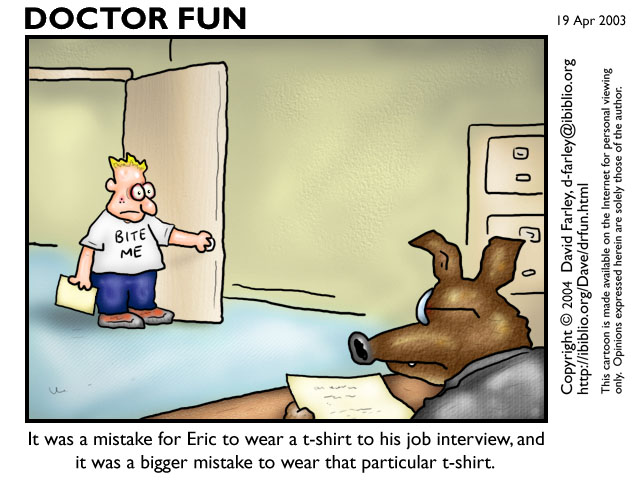
8.     Show up at a job fair in sweats.

7.     Give the employer details about your efforts to get your juvie record sealed.

6.     Talk to a would-be employer at a networking event with your mouth full, and spit food in her face.

5.     Wear a lime-green polka-dot tie to a meeting at a finance company.

4.     Peer into the HR person’s desk drawer and pocket a roll of mints when they leave the room.

3.     Blast Marilyn Manson on your MP3 player while waiting to be interviewed.

2.    Tell the recruiter about how much you hated your last job.

1.    Carry your career portfolio in a plastic Victoria’s Secret bag.

And in case you’re wondering, I have actually witnessed most of these firsthand. Yes, really.

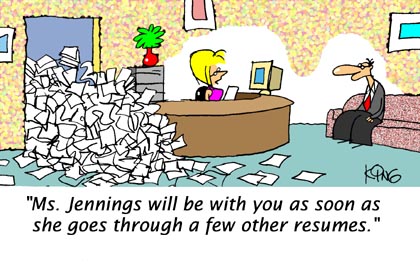
In my job, I see many resumes from desperate job seekers who seem to think the resume spew approach will land them interviews, in much the same way lottery-players think that, even though the odds of their winning are something like one in 10,000, they actually have a shot.

In case you have no idea what the resume spew approach is, it’s the dubious method of job search that consists of spewing your resume out all over the place, to any job you think you may have a chance in hell at.

Usually the resume spew doesn’t include a resume that emphasizes the skills and experience that match what the employer’s looking for, or a cover letter targeted to the specific employer(s) you’re sending it to, telling them how you can help them solve their problems with your talents and experience, much less who they are and why you’re interested in them, as opposed to the other 99 companies to which you spewed your resume. Mostly it doesn’t even reflect jobs or companies that are even remotely a match with your background.

Guess what? The spew doesn’t work. Employers want to know why you’re interested in them, and how you can help them. They don’t want to know that you just found them on the first page of monster.com because their company name starts with “A,” and that you couldn’t give a crap about them specifically. Giving a crap is one of the main things employers look for (more about that in a later post). When you spew, you just piss employers off. Not exactly your goal when you’re looking for a job.